(734) 525-0300

Electrostatic Precipitators

(ESPs)

Airflow Sciences Corporation has been a leader in ESP flow modeling and testing since 1985.  Proper flow through an ESP is critical to optimal performance, as evidenced by many case studies including those shown here.  Improper flow can result in high opacity, spiking during rapping or load changes, unwanted ash buildup, and erosion.

ASC has conducted over 75 flow studies involving ESPs, helping dozens of clients to alleviate various concerns.
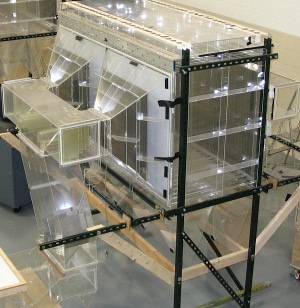
ESP Physical Model
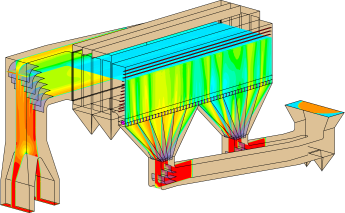
Lateral baseline flow plot
Problem: Poor gas flow distribution through the ESP collection plates. High velocity regions cause particle momentum to overcome electrostatic forces, resulting in suboptimal capture efficiency.

Analysis: Baseline flow model of ESP indicates that current inlet perforated plate design generates non-uniform side-to-side velocities through gas lanes. Lack of outlet perforated plate causes local acceleration in ESP outlet collection field, carrying particulate out.
Solution: Inlet and outlet plates are redesigned using flow model. Highly uniform flow throughout the ESP is generated. Improvements can be significant.Lateral design flow plot
Longitudinal design flow plot

Plant Baseline After Modeling
Southern California Edison Mohave Station Unit 1 & 2 High opacity causes 240 MW unit derate 23% reduction in particulate emissions allows increase in load of 150MW per unit
Mississippi Power Plant Watson Unit 5 Opacity at full load 25% Full load opacity below 5%
Essroc Cement Speed Plant Unit 3 Baseline ESP opacity 14% Opacity reduced to 7%, pressure loss savings of 5 IWC


Entering an ESP to conduct field testsASC also conducts field tests of ESP flow uniformity in a cold-flow condition.  In most ESPs, the test crew enters the ESP from the top, climbs across the collection plates, and lowers the anemometer down the electrode wires or opzels to measure velocity across inlet and exit faces.
Testing Schematic
Vane anemometer on wires


Reducing Particulate Emissions
ASC's field testing group has been quite active lately, performing measurements on a wide range of equipment including pet food dryers, coal pulverizers, electrostatic precipitators (ESPs), and forging Ovens.

Since particulate emissions are a major concern at most industrial facilities, many plants are seeking to optimize their particulate capture equipment in a cost-effective manner. Whether the system involves ESPs, filter bags, or inertial separators, the capture efficiency can be significantly influenced by the flow patterns within the system.


ESP Geometry
Figure 1. ESP Geometry
In a recent test at a coal-fired electric power plant, the goal was to examine flow patters within an ESP (Figure 1) and develop design improvements to enhance ash particle capture.

The customer had several concerns:
Velocity Testing Equipment
Figure 2. Velocity Testing Equipment
Red Ball


ESP performance was marginal, with opacity (a measure of particulate emissions) running 16-19%.
Red Ball

Operating so close to their 20% opacity limit occasionally forced the plant to curtail output.
Red Ball


ESP performance was noted to degrade over time, requiring the unit ti shut down every 50-60 days to wash the ESP.
ASC's engineers utilized specially designed testing equipment (Figure 2) to measure the flow patters through the ESP under air-only operation. The velocity profile entering the ESP was severely out of industry uniformity standards. Through an iterative process, several geometry modifications were installed and evaluated.

A final design was developed that significantly improved the flow distribution. After the unit came back on line, the ESP operated at less that 10% opacity. More importantly, the ESP operated for a full year without any washes.
ESP Performance - Before and After Modifications
  Before After
Inlet Flow Uniformity (RMS Deviation from Avg. Velocity) 27.8% 11.9%
Full Load Opacity 16-19% <10%
Unit Derates Due to Opacity ~10 MW none
ESP Wash Frequency 50-60 days 350 days

Computational Fluid Dynamic Modeling of Electrostatic Precipitators Presentation
Authors: Brian J. Dumont, P.E. & Robert Mudry, P.E.

Presented at Electric Power 2003, Houston, TX USA, March 5th
Outline
Bullet Objectives of Analysis
Bullet Fluid Flow Modeling
Bullet Testing Methods
Bullet Data Comparisons
Bullet Case Studies
Bullet All Case Studies
Bullet Conclusions
Click here to download a PDF version (1.8 MB) of the full presentation.
Click here to download a PDF version (1.1 MB) of the corresponding paper.

ESP Performance Improvement Through CFD Modeling Presentation
Authors: Robert Mudry, P.E. & Brian J. Dumont, P.E.

Presented at the Dec. 11, 2002 PowerGen International
Click here to download a PDF version (2.1 MB) of the full presentation.


ESP Gas Flow Fundamentals Presentation
Robert Mudry, P.E. of ASC Presents at the Aug. 12, 2002 ESP/FF Round Table & Exposition, titled "ESP Gas Flow Fundamentals".
Outline
Bullet Introduction
Bullet ESP Fluid Flow Basics
Bullet Assessing Flow Characteristics
Bullet ESP Flow Modeling
Bullet Case Studies
Bullet Questions
Click here to download a PDF version (3.8 MB) of the full presentation.

All content is copyright 1975-2010 Airflow Sciences Corporation. Do not use without express written permission from Airflow Sciences Corporation.