
by Robert Mudry, P.E.
Airflow Sciences helps to advance the state-of-the-art of firefighting air tanker design
Airflow Sciences is proud to be part of the team designing the next generation of firefighting aircraft. The new fleet of Airbus A319 tankers for Neptune Aviation (Missoula, Montana) feature mechanical design by Aerotec & Concept (Graulhet, France) and fluid dynamic design by Airflow Sciences (Livonia, Michigan). A key technology for the design has been Computational Fluid Dynamics (CFD) simulation of the liquid discharge from the tanks under various conditions.
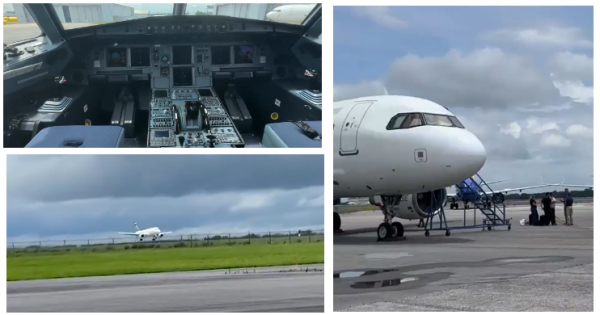
Neptune Aviation takes delivery of its first Airbus A319, landing at the Missoula airport June 2026
(photos courtesy of Neptune Aviation)
The Neptune A319 will be capable of delivering up to 4500 gallons (17034 liters) of retardant to help control wildfires. The CFD modeling by Airflow Sciences has included detailed simulation of both internal tank flows and external retardant tracking.
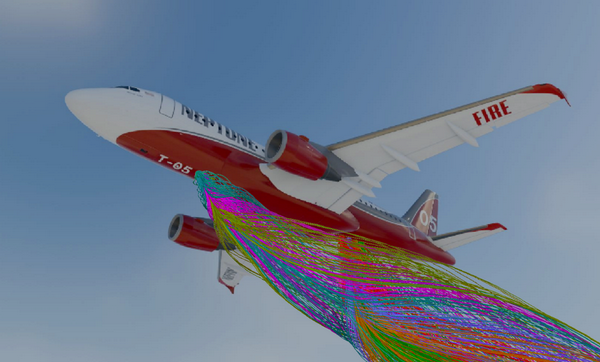
CFD simulation results of liquid droplets emanating from the nozzles in the A319 fuselage
The tanks need to deliver thousands of gallons of liquid (water or retardant) in mere seconds, while maintaining a consistent liquid flow rate vs. time. The CFD modeling activities have examined numerous different tank and valve designs in order to achieve these objectives. Simulations also account for the variable operating conditions the aircraft will experience, such as angle of attack and air speed. The interaction between Airflow’s CFD modeling and Aerotec’s mechanical and dynamic design teams has led to a successful tank design capable of meeting the wide range of operating scenarios.
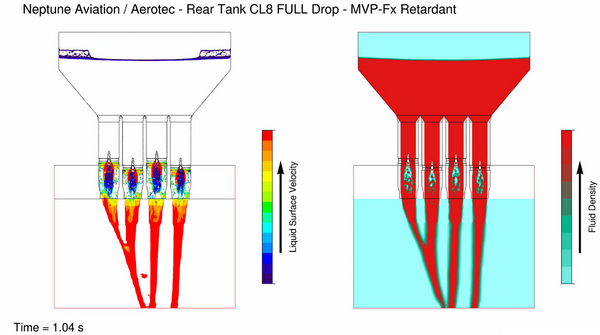
CFD simulation results of tank liquid discharge versus time.
Link: CFD animation of tank liquid discharge
Airflow Sciences Corporation has specialized in fluid dynamic engineering and design since 1975. We perform CFD modeling and laboratory experimental testing for a wide range of industries worldwide.